
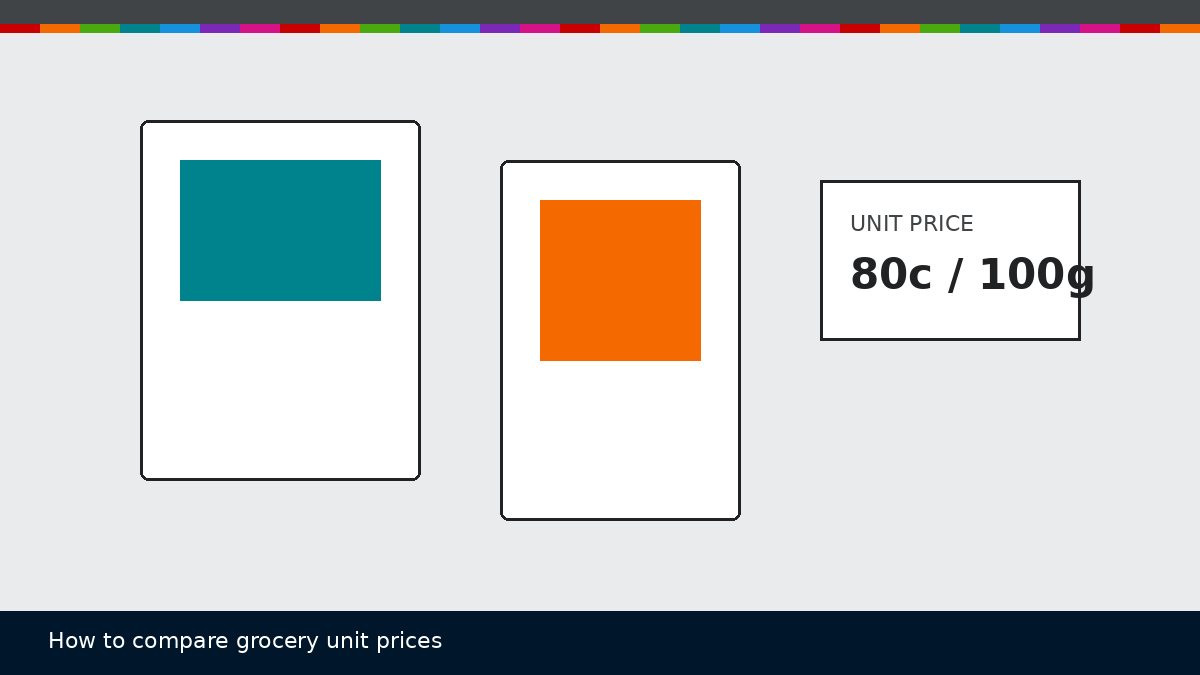
A unit price is a simple idea that is easy to skip when a shop is busy. It restates the ticket price as a rate for a standard unit — often per 100 grams, per kilogram or per litre — so that a 375-gram jar and a 500-gram jar can be compared without mental arithmetic at the shelf.
In Australia, unit pricing is a mandatory feature of grocery retail for many packaged foods and household goods. The figure is printed on the shelf ticket, not invented by a shopping app, and it is meant to be visible at the point of choice. It does not, on its own, tell you which product is better, fresher or more suitable for a recipe. It tells you the cost of a standard quantity.
What the number is
The unit price takes the selling price of the pack in front of you and divides it by the quantity in that pack, then scales the result to a common unit. If a 500-gram pack costs $4.00, the unit price per 100 grams is 80 cents. If a 250-gram pack of a similar product costs $2.40, the unit price is 96 cents per 100 grams. The smaller pack is more expensive for the same quantity, even though the ticket price is lower.
The quantity used for the comparison should be the quantity the product is sold by: grams for a solid, millilitres or litres for a liquid, and so on. Where a pack is sold by count — a bag of ten — the ticket may show a price per item. The useful habit is to read the unit, not only the dollar figure.
What it does not include
Unit prices are calculated on the price printed for that pack, at that moment, in that store. A catalogue special, a loyalty discount that applies only if you scan a card, or a multibuy that requires three units will change the effective price. Some tickets show the special price and a unit price that follows it; others need a second look at the conditions in smaller type. If the cheaper unit price is only available when you buy two, the comparison is not the same as a single-pack price.
The figure also does not adjust for waste, water content or concentration. A bottle of cordial and a bottle of juice are not interchangeable just because the per-litre price favours one of them. A unit price is a cost comparison, not a nutrition or quality score.
How to use it on a shop
Start with products you already buy in more than one size. Compare the unit price on the size you usually take with the next size up, and with the house brand equivalent if there is one. The larger pack is often cheaper per unit, but not always: a special on the smaller pack can invert the usual pattern for a week. That is the point of reading the ticket rather than assuming a rule.
If you are substituting, keep the unit the same. Compare oats per 100 grams with oats, not with a breakfast biscuit measured per pack. When a recipe is built around a particular form — tinned tomatoes versus passata, for example — the unit price can still tell you which tin is the cheaper way to buy that form, but it will not settle a change of ingredient.
A short method
Read the unit on the ticket first. Check that the two packs you are comparing are sold by the same unit. Then look at whether the ticket price is a standing price or a special with a condition. Only after that is the cheaper unit price a safe guide to the cheaper way to buy the same thing.
The aim is not to turn every aisle into a spreadsheet. It is to catch the cases where a familiar pack size, a bold special, or a smaller jar is quietly the more expensive way to take the same goods home.


No comments have been published on this story yet.